Your faith in the gospel of vaccines is about to be shaken to its core.
Alright, folks, gather ‘round. Let’s talk about the diva of infectious diseases: Smallpox. This prima donna graced the stage of humanity for centuries, wreaking havoc and leaving us all scratching our heads (and arms). It wasn’t until 1979 that it took its final bow, officially ‘eradicated’. But was the smallpox vaccine truly the hero of the story, or did the disease just quietly exit stage left on its own terms? Let’s dig in.
Smallpox grabbed my attention after rabies (because, you know, diseases are a fun rabbit hole). Naturally, I had to dive into the drama—cue hours of research, books, and a mild existential crisis about how to cram 200 years of history into a few readable articles. Spoiler: I’m making this a series because succinct isn’t my thing.
The smallpox vaccine is the poster child of vaccination success stories. It’s the star of the show, the Beyoncé of medical achievements. We’re told it saved humanity from unimaginable suffering, wiping smallpox off the face of the Earth with the grace of a mic drop. That narrative has cemented the vaccine as one of the greatest medical discoveries ever, and it’s wheeled out anytime someone wants to champion the cause of vaccines.
Now, let me tell you about my house growing up. Bookshelves for days. Shelves groaned under the weight of Reader’s Digest, Manorama’s Tell Me Why.
Here’s the story we all heard:
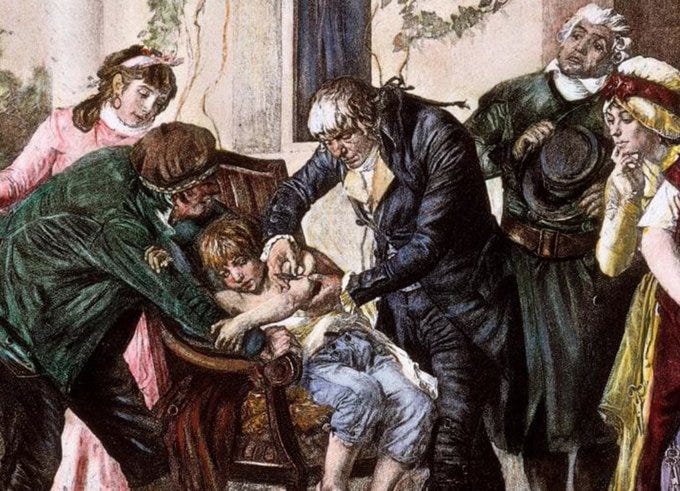
“It was 1796. The idea that cowpox could make one immune to smallpox was still considered folk knowledge, and people viewed it with skepticism as they struggled to fight the smallpox epidemic. This was when a doctor from Berkeley came up with a solution for combating the epidemic. Jenner's method was quite simple. He took the pustular material from a person affected with cowpox and inoculated it into the skin of a healthy person. He did this by taking material from a cowpox vesicle on Sarah Nelmes, a milkmaid, and inoculating it into the arm of a boy named James Phipps. Two months later, he inoculated the boy with smallpox, and the disease did not develop. Jenner published his findings in 1798 under the title ‘An Inquiry into the Causes and Effects of the Variolae Vacciniae.’ Though it sparked opposition initially, it was widely accepted following the procedure's success. This was a keystone achievement in the history of vaccinations.”
Edward Jenner, the OG vaccine influencer, basically said, “What if we just…stick some cow disease into people and see what happens?” And guess what? It worked. Well, kind of. The boy didn’t get smallpox, and Jenner became a legend. Fast forward to today, and Jenner is hailed as the guy who kick-started the whole vaccine revolution, followed by Louis Pasteur.
Many people credit the smallpox vaccine with eradicating smallpox. This is the only human disease which vaccines even receive that credit, by the way. Polio, measles, and every other illness is still out there.
But here’s the plot twist: While many people credit the smallpox vaccine with eradicating the disease, it’s the only human disease to get this honor. Polio? Still around. Measles? Yup, lurking. Smallpox, though? Supposedly gone, except for a few samples chilling in high-security labs (because, hey, who doesn’t love a dystopian “oops, we leaked smallpox” storyline?).
Now, before you go screaming "YES, THE VACCINE DID IT!" and throwing confetti, let’s pump the brakes. Was smallpox truly eradicated by the vaccine, or did it just fizzle out like a bad party guest who overstayed their welcome?
Warning for the Faithful Vaccine Believers If you’re someone who finds comfort in the sacred gospel of vaccines, I recommend you stop reading now. Seriously, hit the back button. What I’m about to reveal will make you question everything. You’ll be like Neo in The Matrix, except instead of dodging bullets, you’ll be dodging awkward conversations at dinner parties. Doctors, this is your last chance. If you keep reading, I can’t be held responsible for your next career crisis.
Alright, So…Smallpox: Extinct or Just Retired? The World Health Organization (WHO) has only declared two diseases eradicated: smallpox (for humans) and rinderpest (for cattle). While smallpox gets a gold star, every other disease on the block—polio, measles, diphtheria, tetanus, you name it—is still hanging out. Sure, they’re less common, but eradicated? Not even close.
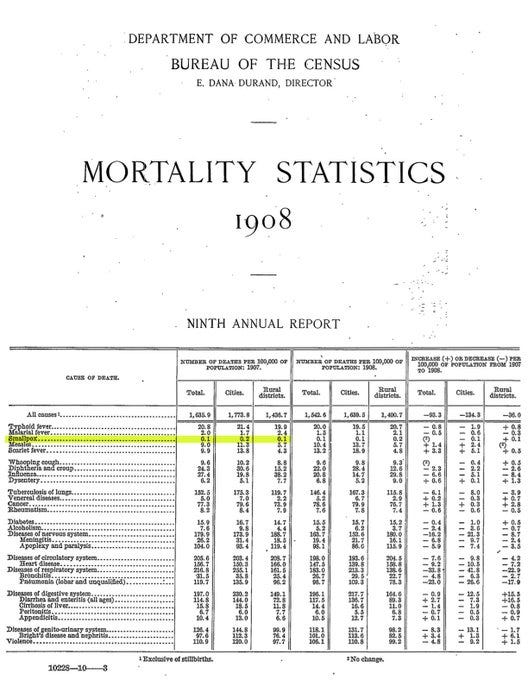
Contrary to the shiny PR, we can argue that the smallpox vaccine didn’t actually eradicate the disease. Instead, smallpox may have just faded away naturally, as diseases often do over time. By 1908, smallpox was so weak it barely made a dent in mortality charts. For perspective, malaria killed 20 times more people in the U.S. than smallpox did around that time(see chart below).
What Does “Eradicated” Really Mean? Let’s be precise here. When we say a disease is eradicated, we mean it’s gone. Not just “we don’t see it much anymore,” but extinct. Poof. The virus doesn’t exist in nature, in people, or in any shady corner of the world. It’s as if it never was. The genetic descendants of small pox still exist in nature. (We’ll conveniently ignore the smallpox samples stashed in labs, because apparently, we just had to keep a few for science dystopian sci-fi writers to lose sleep over.)
All other diseases are still alive and kicking — that includes Polio, Measles, Mumps, Rubella, Diphtheria, Tetanus, Pertussis, Influenza, Pneumococcal, the plague, cholera, scarlet fever, mumps, chickenpox, rubella, and the recent ones — HIV/AIDS, Ebola, Zika, Respiratory Syncytial Virus (RSV), and the list goes on. But Smallpox—eradicated. Every other disease—not eradicated. Certainly less prevalent, it would appear—no one would argue that point. But if you want to talk about eradication (in the past tense), we can only talk about Smallpox.
Diseases, like hurricanes, tend to have a lifecycle of their own. The Black Death came and went in the 1300’s, taking an estimated 75 to 200 million lives. The Spanish Flu of 1918 lasted two years (I know, two years) and killed 50 to 100 million. Both diseases, came and went, without a vaccine. There are many others, of course that have come and gone with no vaccine, but what about small pox? Was it just coincidence that the small pox vaccine was discovered towards the natural end of small pox’s terrible run, or did it in fact change the course of smallpox in history?
You’ll see that nonexistent is difficult to achieve with viruses, even when we try very, very hard. Eradicated means human intervention made an otherwise thriving virus or bacteria extinct. Eradicated means that without human intervention, the virus or bacteria would still exist.
The purpose of ‘immunisation’ is to eradicate ‘infectious diseases’; yet, despite the practice having existed for more than two centuries, the only human ‘infectious disease’ that is claimed to have been successfully eradicated is smallpox. But this is hardly a cause for celebration, as the number of ‘infectious diseases’ claimed to exist has risen dramatically over the same period of time.
Contrary to popular opinion, the smallpox vaccine did not eradicate smallpox. Smallpox died a natural death, like all infections do over time. By 1908, smallpox had become so weak it barely registered on mortality charts. Malaria killed 20x more in the U.S. than smallpox.
Next Up: The Truth About Other Vaccines If you’re feeling brave, stick around for the next article, where I’ll dig into whether vaccines have actually reduced the prevalence or deadliness of other diseases. Spoiler: the answers may surprise you. Or infuriate you. Or both.
In the meantime, here are some links to start questioning everything you thought you knew:
Thanks for reading! Don’t forget to subscribe to Harsh’s Substack for more revelations, rabbit holes, and a healthy dose of skepticism. You’ll thank me later—or curse me at your next family gathering. Either way, it’ll be fun!
Thanks for reading Harsh’s Substack! Subscribe for free to receive new posts and support my work.