Quackery
The brief history of the snake oil salesman and modern medicine.

Humbug. Charlatan. Quack. Con artist. Swindler. Trickster. Snake Oil Salesman.
These words slice through history like accusations.
These weren't mere accusations—they were visceral reactions, whispered in towns across 19th-century America, marking those who transformed our deepest fears into profit. These merchants of false hope preyed upon our most primal terrors: death and disease.
Their weapons?
Tonics that didn't just fail to heal—they sometimes killed.
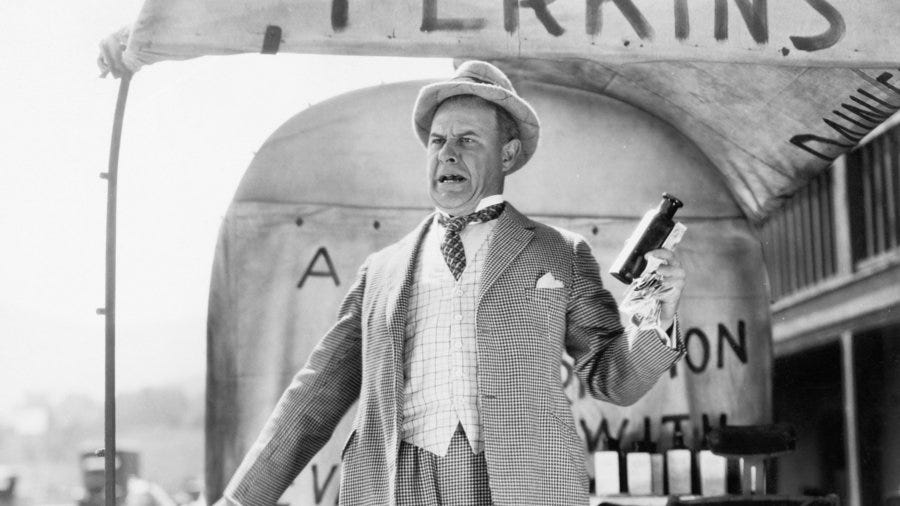
The snake oil salesman is a historical trope; he's crystallized into legend. Picture him: commanding the town square, his practiced smile gleaming as bright as the bottles he holds aloft. A staged performance unfolds—his plant in the crowd gasps at miraculous cures, while desperate townspeople reach for their life savings, trading hard-earned dollars for colored water and empty promises.
Enter William Levingston—a man who could have been drawn straight from central casting for this particular brand of villain. His chosen title dripped with prestige: "Dr. Bill Levingston, Celebrated Cancer Specialist."
The truth is far less impressive: he was no doctor, had never been celebrated, and his knowledge of cancer extended only as far as its ability to loosen purse strings.
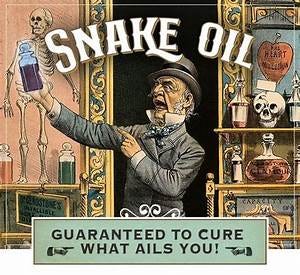
Levingston's deceptions weren't limited to his professional claims. Behind the respectable facade lurked a man who treated families like disposable commodities—abandoning his first wife and six children to pursue a bigamous marriage in Canada, all while fathering two more children with yet a third woman. His personal life was a spider's web of lies, each strand carefully spun to serve his purposes.
Like all of his kind, Levingston had a miracle cure to peddle. He called it "Rock Oil," and its price tag was staggering: twenty-five dollars a bottle—equivalent to two months' wages for the average American worker. The cost was astronomical, but to those facing death's shadow, what price is too high? In every town, there were always those desperate enough to believe his grandiose claims that his tonic could cure nearly any cancer.
"Rock Oil" was nothing more than a worthless mixture of laxative and petroleum, as ineffective against cancer as water against a wildfire. But by the time his victims realized they'd been duped, "Dr. Bill" was already gone, leaving behind nothing but empty promises and lighter purses. Like a phantom, he never materialized in the same place twice, ensuring the consequences of his cons could never catch up to him.
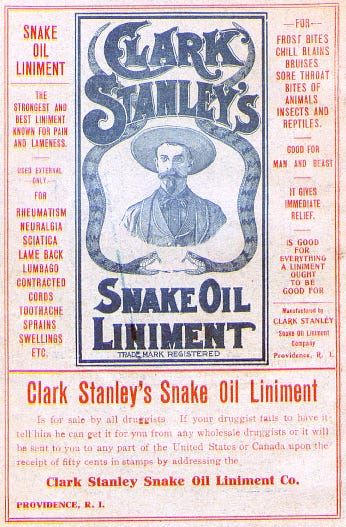
By all appearances, William Levingston was just another conscience-free swindler, one of countless charlatans who prowled America's frontier towns. But beneath this mundane facade lay a secret that would reshape American history. "Levingston" was merely a convenient mask, donned in 1849 after he was indicted for raping a girl in Cayuga. His true identity? William Avery Rockefeller—father of John D. Rockefeller and patriarch of America's most infamous dynasty.
The sanitized histories of the Rockefeller empire—carefully curated through family-commissioned books and family-controlled public television stations—delicately sidestep this unsavory foundation. Yet the evidence remains, written in the swagger of "Devil Bill," who boasted of his own duplicity: "I cheat my boys every chance I get. I want to make 'em sharp." And sharp they became, none more so than young John D. Rockefeller, whose precocious shrewdness marked him as his father's true heir. The elder Rockefeller's lessons in deception and manipulation would prove invaluable as John ascended to unprecedented heights of wealth and power.
Like father, like son—on a grander scale. Where William Avery peddled worthless tonics, John D. built an empire on another kind of snake oil. Starting with a modest Cleveland refinery in the 1860s, he engineered Standard Oil into a behemoth that controlled 90% of America's oil refinement by 1880. His tools were familiar—deceit, betrayal, and backroom dealings with railroad barons—but his success was unprecedented, forged in the crucible of his father's teachings.
Initially, oil's domain was modest—primarily refined into kerosene for lighting. Though profitable, it was far from essential to American life, and the advent of Edison's electric light bulb in 1878 threatened even this foothold. But fate and innovation intervened. The emergence of the horseless carriage, powered by gasoline-fueled internal combustion engines, would transform oil from a mere commodity into the lifeblood of American society. Alongside industrial toxins like arsenic, mercury, and antimony, petroleum became the defining snake oil of the twentieth century—not sold in bottles on street corners, but pumped through the very arteries of modern civilization.

In those early days of America, vast distances held the states apart like separate worlds. The railroad was the only thread binding them together, and so the frontier bloomed along its steel veins. History would echo this pattern decades later—as the automobile replaced the iron horse, modern America would reshape itself around highways and byways, with twentieth-century snake oil salesmen like the Rockefellers orchestrating this transformation from behind the scenes.
Today, oil doesn't just power our world—it is our world. Its invisible hand touches every aspect of modern life: our cars gulp its refined essence; our tires flex with its polymers; our store shelves groan under the weight of plastic goods swaddled in yet more plastic. Oil seeps deeper still—into our medicine cabinets through Big Pharma's formulations, into our soil through Big Agra's fertilizers, onto our dinner plates through Big Food's additives.
Here lies the twisted genius of modern snake oil salesmen: they've moved beyond merely selling false cures—they've become architects of affliction. They create the disease, sell the remedy, and forge the chains of dependence that bind us to their system. Somewhere, William Avery Rockefeller must be smiling at this dark evolution of his craft.
Yet beneath their apparent invincibility lurks a primal fear—one that haunts today's corporate titans just as it once haunted street-corner charlatans. Whether they're banksters gambling with our futures, oilmen drilling into our planet's veins, multinational corporations colonizing our economies, or their political puppets dancing in marble halls, they all share the same nightmare: the moment when the audience sees through the act, recognizes the worthlessness of their tonic, and the carefully constructed stage crumbles beneath their feet.

The quest to understand disease transmission has birthed revolutionary advances—modern sanitation and basic hygiene chief among them. With advances in nutrition sciences, many diseases that were initially thought to be infectious were later discovered to be nutritional deficiencies. Gone are the days when surgeons moved directly from autopsy to operating theater with unwashed hands. Today's physicians operate in sterile environments on anesthetized patients. Yet modern medicine still grapples with fundamental mysteries: why some patients resist anesthesia, how cancer truly works, and the labyrinthine complexities of our immune system—a realm even more enigmatic and unexplored than the human brain itself.
The energetic biofield remains largely unexplored, while historical afflictions resurface under new names—smallpox and syphilis rebranded as monkeypox and various skin eruptions. Progress has come at a steep price: countless patients sacrificed to medical trial and error. Even now, iatrogenic death—death by medical error—stands as the third leading cause of mortality, preceded only by heart disease and cancer.

Desperation breeds vulnerability. In our race to escape disease and extend life, we embrace solutions as toxic as the ailments they claim to cure: metal-laden injections, and petroleum-based pharmaceuticals. This hunger for longevity proves as addictive as opium itself. Modern scientists, like Icarus flying too close to the sun, compete to create increasingly potent drugs and vaccines. Where ancient emperors once dispatched alchemists on futile quests for immortality, today's medical entrepreneurs offer quick fixes like implanted testicles.
But mere health isn't enough for many—we chase perfection. Modern medicine excels here, convincing us that estrogen injections can transform a castrated man into a woman. While we might chuckle at historical medical and religious practices, many of their modern counterparts continue unchallenged.
None of us stand immune to the allure of the quick fix. Yesterday's snake oil customer is today's flu shot recipient. True wisdom lies in recognizing our body's innate intelligence and healing capacity. There are no shortcuts to health—it's a journey guided more by our belief systems than by any external intervention.
The Food and Drug Administration emerged in 1930 as America's medical watchdog, but the guard dog seems to have curled up in its master's lap. By 2021, as reported by the University of Connecticut, nearly half the FDA's budget flowed from the very pharmaceutical companies it was meant to regulate. Even more telling: nine of the ten FDA commissioners who served through 2019 later took positions with pharmaceutical companies—a revolving door spinning between regulator and regulated.
History occasionally offers ironic vindication—leeches, once dismissed as quackery, have found legitimate medical applications. Yet other questionable practices persist: tapeworm diet pills, petroleum-based medicines, and injections laced with plant, animal, and metallic toxins continue to masquerade as cutting-edge treatments.
To truly combat medical charlatanism, we need to transcend our reliance on cadaver-based knowledge and develop a fuller understanding of the living body. This requires both skepticism and openness—particularly regarding disease and nutrition. Most critically, we must remain vigilant. Modern snake oil salesmen haven't vanished; they've simply exchanged their traveling wagons for corner offices, wielding authority and credentials as their new tools of persuasion.
But how does one navigate this landscape with both skepticism and an open mind? Remember that today's quackery often comes dressed in scientific clothing, backed by celebrity physicians and impressive-sounding studies. Even when research appears rigorous—peer-reviewed and repeatedly tested—it may not tell the whole story. These studies rarely account for the powerful psychosomatic dimension of illness or the nocebo effect's role in disease outbreaks.
Ultimately, three questions cut to the heart of any medical decision:
Do you truly believe in the treatment?
Are you prepared to accept its risks?
And perhaps most pragmatically—can you afford it?
Medicine's history reads like a catalog of increasingly sophisticated mistakes. And tomorrow's "breakthrough treatments" may well be destined for the same dustbin of medical misadventure.
Sources:
https://corbettreport.com/meet-william-rockefeller-snake-oil-salesman/
https://www.history.com/news/10-things-you-may-not-know-about-john-d-rockefeller
https://corbettreport.com/episode-321-why-big-oil-conquered-the-world/
https://www.jtrue.com/blog/snake-oil-messiah
Books: